
Slatted Fencing: Everything You Need to Know
Published on 5 May 2026
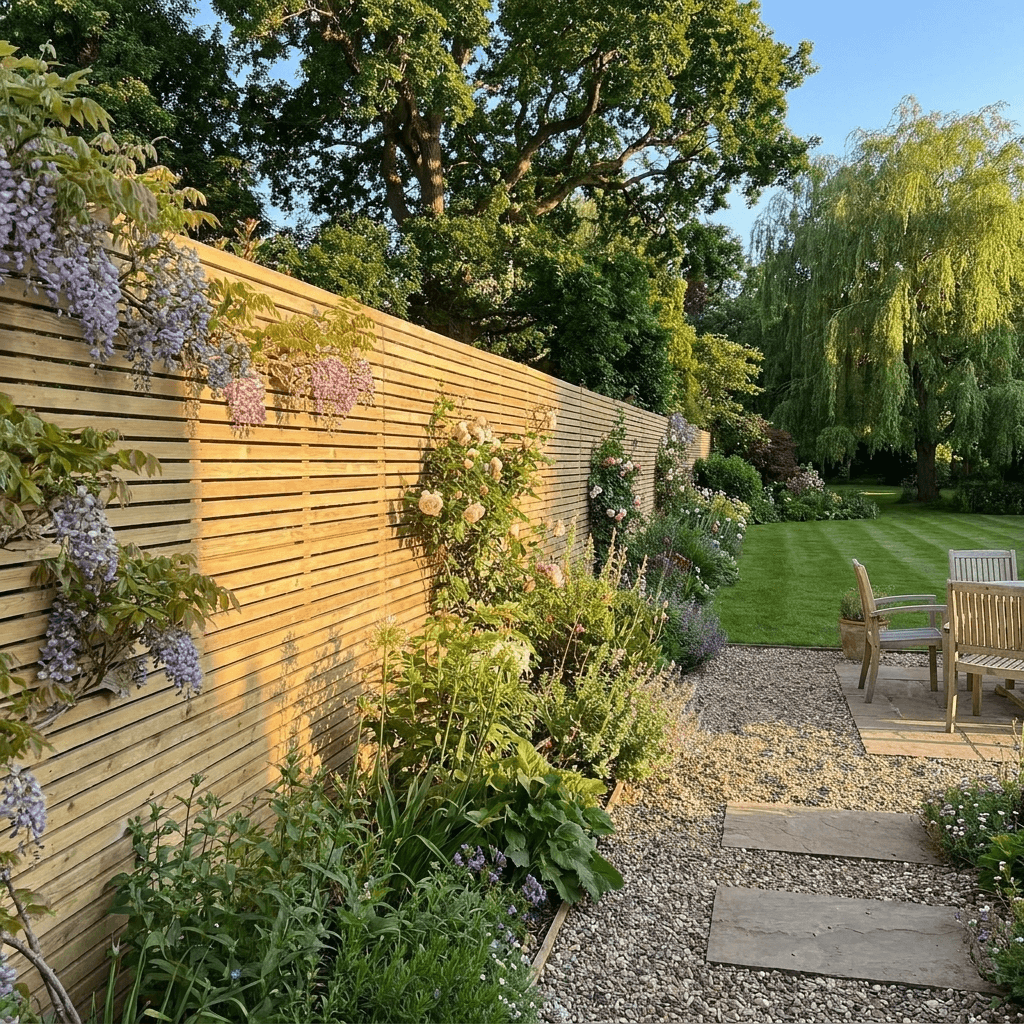
The definitive guide to contemporary timber slatted fencing, from choosing the right timber, to installation, planning rules, costs and maintenance.
Slatted fencing (also known as Venetian fencing or open-joint fencing) is a contemporary fence style built from individual timber battens (slats) fixed horizontally or vertically with a gap between each slat, typically 10mm. The result is a clean, modern aesthetic boundary with practical benefits including improved light, airflow, and wind resistance. One of the most popular and accessible choices for UK gardens is green treated (pressure-treated) softwood. It is durable, versatile, easy to work with and, in England, you can install a slatted fence up to 2 metres high without planning permission (1 metre adjacent to a road).
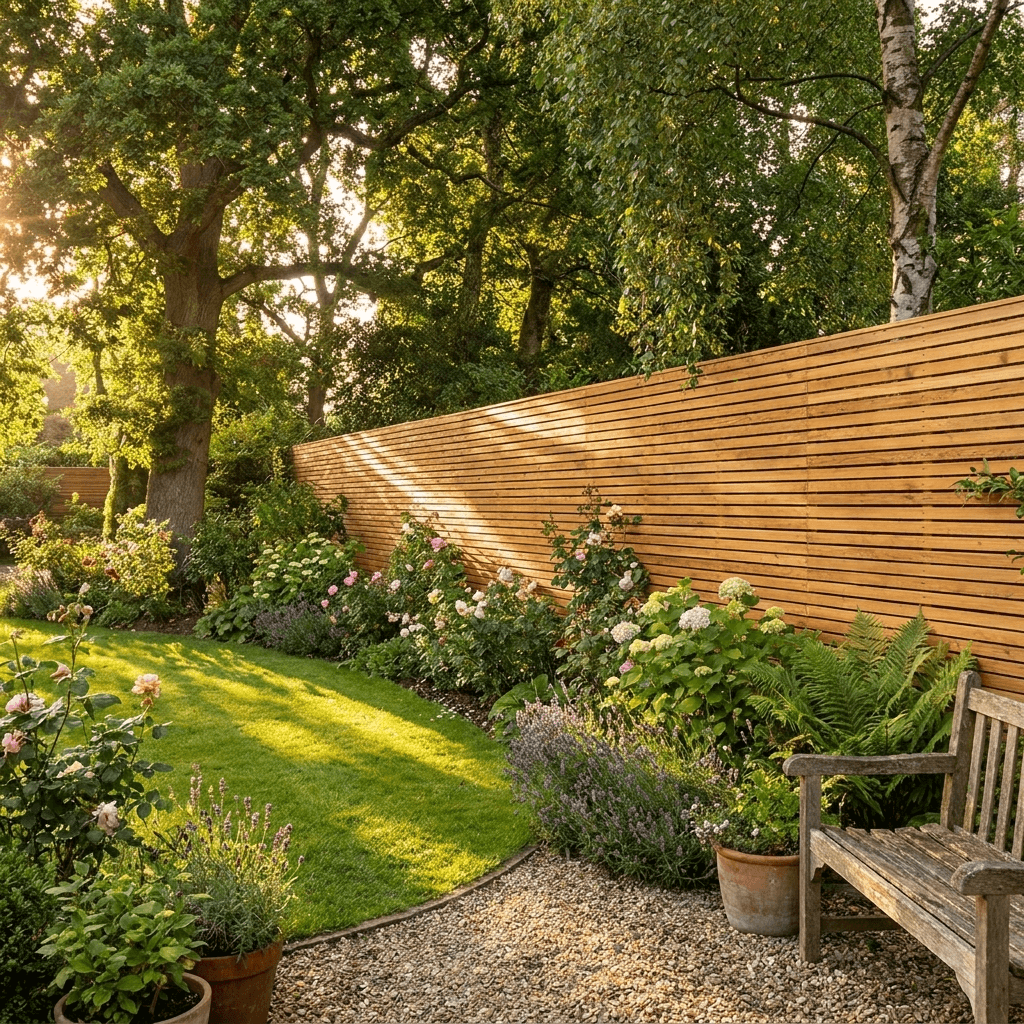
Contents
- What is slatted fencing?
- Benefits of slatted fencing
- Why choose green treated softwood?
- Styles, orientations and sizes
- Planning permission and regulations (UK)
- How much does slatted fencing cost?
- How to install slatted fencing
- Privacy and double-sided fencing
- Care and maintenance
- Design ideas and inspiration
- Frequently Asked Questions
1. What Is Slatted Fencing?
Slatted fencing is a style of garden or boundary fence built from individual timber slats or battens, fixed to structural posts with a small, consistent gap between each board. Unlike traditional solid panel fencing, each slat stands independently. This open-joint construction is what gives slatted fencing its distinctive character: clean, linear shadows in sunlight, a sense of spaciousness, and a flow of fresh air that solid fencing simply cannot provide.
You may also hear it called Venetian fencing, horizontal screen fencing, open-joint fencing or contemporary slatted panels. The names all refer to the same core design.
The rise of contemporary landscaping has caused a surge in popularity for slatted fencing in the UK. Self-build projects and the desire to create outdoor living spaces have also contributed to the increase. It works equally well as a boundary fence, a garden screen, a pergola infill, or a dividing panel between zones within a larger garden.
Green treated softwood is by far the most widely used timber for slatted fencing in the UK and for good reason. It is cost-effective, readily available, easy to cut and fix, and with quality pressure treatment, more than capable of delivering many years of reliable outdoor performance. Timber treated by us is always treated to Use Class 4, providing an outstanding level of protection.
We’ve been supplying fencing timber from our yard in Silverstone, Northamptonshire since the 1880s, and green treated softwood remains our best-selling fencing timber year after year.
2. Benefits of Slatted Fencing
Aesthetic appeal
The horizontal or vertical lines of a slatted fence create an aesthetic that immediately elevates a garden’s appearance. The gaps between the slats cast linear shadows that shift throughout the day as the sun moves, which produces a living, dynamic quality that no static solid panel can replicate. At night, garden uplights or downlights draw out the same geometry in a completely different way, turning the fence into a design feature that stands out whether day or night.
Natural light and airflow
Standard solid fencing can block light and create a turbulent wind shadow, which could be damaging for particularly sensitive plants. Slatted fencing allows light to filter through, which is particularly valuable in smaller gardens and courtyards. The gaps also enable air to move gently through the fence rather than being forced over it. This reduces pressure on the posts, makes the fence more resilient in storms.
Space and proportion
Installed horizontally, slatted fencing draws the eye along the fence line, creating a visual elongation that makes narrow or compact gardens feel considerably larger. It is one of the most effective, and cost-effective, ways to transform the perceived proportions of a smaller outdoor space.
Versatility
Green treated softwood slatted fencing is equally at home in urban terraced gardens, rural properties and commercial landscaping projects. It can be left to weather naturally, stained in any colour, or painted to match your home’s exterior. Slats can run horizontally, vertically or diagonally, and because softwood is so easy to work with, cutting and shaping on site is straightforward even for confident DIYers.
Durability you can count on
Quality pressure treatment such as Tanalith E, the industry standard used at our Silverstone treatment plant, forces preservative deep into the timber fibres, providing lasting protection against fungal decay, rot and insect attack. A well-treated green softwood slatted fence, properly installed and maintained, will give you at least 15 years of solid service – longer with regular maintenance. That is a lot of garden enjoyment for a very sensible investment.
Great value without compromise
Premium timber species such as Western Red Cedar and Larch command a significant price premium. Green treated softwood delivers a genuinely attractive, practical and durable slatted fence at a fraction of the cost, making it the right choice for homeowners who want a quality result without overspending, and the go-to specification for landscapers and contractors managing project budgets.
3. Why Choose Green Treated Softwood for Slatted Fencing?
Green treated softwood (also referred to as pressure-treated softwood or tanalised timber) is pine or redwood that has been impregnated with a water-based preservative under pressure. The “green” refers to the colour imparted by the preservative, which fades to a natural timber tone over the first season outdoors.
How pressure treatment works
The timber is loaded into a sealed cylinder. The cylinder is pressurised, forcing the preservative solution deep into the wood’s cellular structure, far deeper than any brush-applied treatment. The result is protection that works from the inside out, not just on the surface. This is why pressure-treated timber outperforms untreated timber so dramatically in outdoor conditions.
At Linnell Bros, we treat timber at our own on-site plant in Silverstone using quality, industry-leading preservatives. Because we control the process ourselves, we can guarantee the treatment standard of every piece of timber we supply.
Durability class and expected lifespan
All of the softwood timber supplied by Linnell Bros for slatted fencing is pressure-treated to Use Class 4 (UC4), which is the standard for timber in ground contact. This is actually a higher level of treatment than the above-ground UC3 specification that many suppliers use for fencing components, meaning our timber is built to withstand the most demanding conditions it will face, including where posts meet the ground. The treatment forces preservative deep into the timber fibres, providing long-lasting protection against fungal decay, rot and insect attack from the inside out.
Expected service life: at least 15 years, depending on installation quality, local conditions and periodic maintenance. That is a lifespan that represents outstanding value at softwood price points and with UC4 treatment as standard, you are starting from the strongest possible foundation.
Ease of working
Softwood is significantly easier to cut, drill and fix than hardwoods or naturally durable species such as Larch. Standard woodworking tools handle it with ease. Pre-drilling is not required for fixing (though recommended near board ends). Screws drive cleanly and quickly. For DIY installers in particular, this makes a material difference to how smoothly and efficiently the project goes.
Paintable and stainable
Green treated softwood accepts paint and stain exceptionally well once the initial green preservative colour has faded and the timber has dried out, which is typically after the first season. This gives you complete freedom to finish the fence in any colour: classic dark charcoal, natural timber tones, deep green, or brilliant white for a Scandinavian-inspired look.
4. Styles, Orientations and Slat Sizes
Horizontal vs. vertical slatted fencing
Horizontal slatted fencing is currently the dominant style in UK contemporary garden design. The eye-level lines draw the gaze along the fence run, making it feel longer and wider. It is particularly effective in narrower gardens where height would feel oppressive and width is at a premium. Green treated softwood in a horizontal configuration, finished in a dark stain or paint, is one of the most popular garden upgrades we see.
Vertical slatted fencing has a more classical heritage – think traditional palisade and picket forms reinvented in a clean, modern profile. Vertical slats can lend height and grandeur to a space, and work particularly well on larger plots, driveways and formal garden settings.
Slat width and gap sizes
Standard slat widths for softwood slatted fencing range from 45 mm to 90 mm. Narrower slats (45 mm) produce a more intricate, layered appearance. Wider slats (70–90 mm) give a bolder, more architectural look and offer greater privacy. The gap between slats is most commonly 10 mm, which is enough to allow airflow and light without compromising the fence’s function as a screen.
Single-sided vs. double-sided
A standard single-sided slatted fence looks its best from one side (the face without visible fixings). A double-sided design adds a second row of slats on the reverse of the posts, offset to cover the gaps seen from the neighbour’s side. The result is a fence that looks equally finished from both directions. This is an increasingly popular choice in shared boundary situations, and very achievable with softwood at sensible cost.
Posts and structural members
Fence posts for slatted fencing are typically 75 × 75 mm or 100 × 100 mm section, set at 1.8 m centres maximum for most slat sizes. Rails running behind the slats (typically 75 × 47mm) can help spread the structural load and allow greater post spacings on larger projects. Note this is only applicable if you intend to mount the slats vertically. All posts and structural members should be pressure-treated to Use Class 4 (ground contact) standard, which is suitable for direct soil contact.
5. Planning Permission and UK Regulations
The quick rule: In England and Wales, slatted fencing up to 2 metres high in a rear or side garden does not require planning permission. Adjacent to a road, public footpath or front garden boundary, the maximum height without permission is 1 metre. Additional restrictions apply to listed buildings, conservation areas and areas of outstanding natural beauty.
Standard height limits
For most residential properties in England and Wales: rear and side garden fences up to 2 metres require no planning permission. Fences adjacent to a highway used by vehicles, including your front boundary or a side boundary on a corner plot, must not exceed 1 metre without permission. In Scotland and Northern Ireland, check with your local authority as rules can differ.
When you always need planning permission
Regardless of height, you will need planning permission if your property is a listed building or sits within the curtilage of one; if your site is within a designated conservation area, national park, AONB or World Heritage Site; or if your deeds or a planning condition specifically restricts fencing. Always check your title deeds and contact your Local Planning Authority if in any doubt.
How fence height is measured
Height is measured from natural ground level, not from a raised patio, a retaining wall or a gravel board. Trellis or other topper structures count towards the total height. A 1.8 m panel with a 0.3 m trellis topper reaches 2.1 m total, which would normally require permission at the rear. The most common practical solution is a standard 1.8 m (6ft) panel, which sits comfortably within the 2 m limit after adding a capping rail.
Neighbour considerations
You can build a fence entirely on your own land without your neighbour’s consent, provided it meets planning rules. If your fence falls on the shared boundary line, you’ll need written agreement from your neighbour. You must never attach anything to your neighbour’s fence without their permission. It is always good practice to discuss your plans before starting work.
6. How Much Does Green Treated Softwood Slatted Fencing Cost?
Green treated softwood is the most budget-friendly timber choice for slatted fencing, and with our current promotional offer, the value is even stronger.
Linnell Bros supplies slatted fencing as individual components, giving you full control over exactly what you order and how much you spend. Everything you need is available directly from our product page, with two batten length options to suit different project sizes.
Why softwood represents outstanding lifetime value
At the budget end of the timber spectrum, green treated softwood delivers a fully functional, attractive slatted fence at the lowest entry cost. And unlike cheaper alternatives, quality pressure-treated softwood from a reputable merchant, treated to the correct standard at source, can last at least 15 years with periodic maintenance.
Because we mill and treat on site at Silverstone, we cut out multiple handling stages in the supply chain. Combined with the current 10% offer, you’re getting direct-from-the-yard pricing on timber that has been treated to our own exacting standards.
7. What You’ll Need: Materials and Installation Guide
Choosing your batten length
Linnell Bros slatted fencing produces a 6ft (1.8m) high slatted fence with 10mm gaps between battens, using 100×100mm posts set at 1.2m centres.
4.8m battens (covers a 4.8m run / 4 bays):
- 33 x 4.8m battens
- 5 x 2.4m 100×100mm posts
- 1 x 1kg 50mm nails
- 5 x post mix
If your fence run is longer than a single option covers, simply order multiple quantities. For example, two sets of fencing with 4.8m battens will cover a 9.6m run. If you’re unsure what you need for your specific project, call our team on 01327 354422 and we’ll work it through with you.
Tools you’ll need
Post hole digger or auger; spirit level (minimum 600mm); string line and pins; tape measure; circular saw or hand saw; drill and screwdriver bit; safety goggles and gloves.
Before you start
Mark out your fence line with a string line and confirm the total run length. Identify any obstacles including tree roots, underground services, changes in ground level. Make relevant enquiries to check for any pipes and cables underground before you start to dig.
On sloping ground, a stepped design where each bay drops in height at each post rather than following the slope, is the most practical approach for slatted fencing and gives the cleanest result.
Step 1: Set your first and last posts
Dig your first and last post holes to a minimum depth of 600mm – one-third of the 2.4m post length, which is the standard rule for post foundations. Pour fast-setting post mix into the hole around the post following the manufacturer’s instructions. Check for vertical accuracy on two faces with your spirit level and brace with temporary timber stays while the mix sets. Leave overnight before applying any load.
Step 2: Run your string line
Fix a string line between the first and last post at the intended finished top height of the fence. This is your reference for setting all intermediate posts at exactly the right height and alignment. A straight, taut string line is the single most important tool on this job. Time spent here saves a great deal of frustration later.
Step 3: Set your remaining posts
Set each intermediate post in the same way as the first and last, checking height against your string line and vertical accuracy with the spirit level at every post. Allow all post mix to set fully before moving on to fixing battens.
Step 4: Pre-finish your battens (optional but recommended)
If you plan to stain or paint the fence, do so before fixing the battens in place. You can coat all four faces of every batten, including edges and cut ends, far more easily before they are installed. Allow to dry fully before fixing.
Step 5: Fix your first batten
Start at the top. Level your first batten with a spirit level and nail it into place. Two nails per batten per post is standard. Pre-nail close to board ends to prevent splitting.
Step 6: Use spacers for consistent 10mm gaps
Cut two short lengths of timber to exactly 10mm and use these as spacers to position every subsequent batten. This is significantly faster and more accurate than measuring each gap individually, and produces the consistent, clean result that makes slatted fencing look its best.
Step 7: Work down to the bottom batten
Continue methodically down the fence run. Check for level every three or four battens and make minor adjustments through the gap spacing if needed. Small corrections across multiple battens are invisible to the eye. Repeat across all bays.
Step 8: Finish
Fit post caps to prevent water pooling on post end grain. Apply a coat of stain or paint to any cut ends or exposed bare timber. Stand back and enjoy the result.
Please note: Linnell Bros supplies materials only. Installation is not included and customers should arrange their own. Quantities should be confirmed carefully before ordering. Our team is happy to help if you need guidance.
8. Privacy and Double-Sided Slatted Fencing
The most common question about slatted fencing is privacy. With a 10 mm gap between slats, a standard design does not provide complete visual screening, but there are straightforward ways to achieve the level of privacy you need, all very achievable with green treated softwood.
Double-sided construction
A double-sided slatted fence places a second row of slats on the reverse of the fence posts, offset by half a slat width so that rear slats cover the gaps between front slats. The result is complete visual privacy from both sides, while still allowing excellent airflow through the overlapping boards. This is an especially cost-effective upgrade when using green treated softwood. The additional material cost is modest, the privacy benefit is significant.
Angled slats
Some contemporary designs angle the slats slightly – typically 15–30 degrees – so that they admit light and air from above but block sightlines from adjacent properties at eye level. Softwood handles the angled cutting required very easily.
9. Care and Maintenance of Green Treated Softwood Slatted Fencing
One of the practical advantages of green treated softwood is that it is a known quantity. UK homeowners and landscapers have been maintaining it successfully for generations. Here is what good maintenance looks like in practice.
Annual inspection
Once a year, ideally in early spring, walk your fence and inspect it. Look for loose fixings (tighten or replace), boards that have shifted (re-fix), surface mould or discolouration (clean and retreat), and any soft or spongy areas that could indicate decay (address promptly before it spreads to the post).
Cleaning
Use a stiff brush and a proprietary timber cleaner to remove algae, lichen, mould and surface grey. A gentle pressure wash can speed this up, although ensure you use low pressure to avoid raising the grain. Allow the timber to dry fully (at least 48 hours of dry weather) before applying any finish.
Staining and painting
Green treated softwood accepts fence stain and exterior paint very well, especially after the first season when the initial green colouring has faded and the timber has dried. Apply a quality fence stain or paint every 2–3 years to refresh the colour and add a further layer of surface protection. This is quick, simple work that makes a big visual difference and meaningfully extends the life of the fence.
10. Design Ideas and Inspiration for Softwood Slatted Fencing
Dark stained finishes
Black and dark charcoal fence stains are enormously popular on green treated softwood slatted fencing. The dark colour recedes against planting, pushing greenery forward and giving the garden real depth. Applied to a horizontal slatted design, the effect is clean, modern and impressive, at a cost that won’t break the project budget.
Classic natural wood tones
A mid-brown or honey-coloured fence stain on horizontal softwood slats gives a warm, naturalistic feel that works beautifully in family gardens and rural settings. It softens the look of the slatted design and complements most planting palettes.
White and light finishes
For a Scandinavian or coastal-inspired garden, a light grey or off-white stain on softwood slatted fencing is a striking choice. It brings a brightness and airiness to the space and provides a wonderful backdrop for dark-leaved plants or bold garden furniture.
Integrated lighting
Slatted fencing takes garden lighting particularly well. Even simple solar-powered post-top lights or clip-on fence lights transform green treated softwood slatted fencing into a warm, atmospheric evening feature. For a more permanent effect, run low-voltage LED cabling through conduit in the posts to power recessed uplights or downlights.
Using slatted panels as internal dividers
Green treated softwood slatted panels are not just for boundaries. Use them to divide a garden into distinct zones, for instance screening a utility area, separating a play zone from a dining terrace, or framing a seating area. Because softwood is so affordable and easy to work, you can create multiple panels across a garden without a significant budget impact.
11. Frequently Asked Questions
Green treated softwood (also called pressure-treated or tanalised softwood) is pine or redwood timber that has been impregnated with a water-based preservative under pressure. The green colour is caused by the preservative and fades to a natural timber tone within the first season outdoors. The treatment protects the timber against rot, fungal decay and insect attack, elevating its effective durability class to UC4.
With quality pressure treatment and periodic maintenance, at least 15 years is a realistic expectation. The open-joint construction of slatted fencing promotes airflow around each slat, helping the timber dry after rain which supports longevity.
Absolutely! Once the initial green colour has faded and the timber has dried out after the first season outdoors, green treated softwood accepts exterior paint and fence stain very well. For a stained look, a quality one- or two-coat fence stain applied with a brush or roller is all that is needed.
Always use hot-dipped galvanised or stainless steel screws. The preservative in pressure-treated timber accelerates corrosion in standard zinc-plated fixings, which leads to rust staining and premature fixing failure.
Yes! Softwood is one of the easiest fencing timbers to work with. It cuts cleanly with standard tools, accepts screws without pre-drilling in most situations, and is light enough for one person to handle comfortably. The most important element is setting posts accurately. Get the posts right and the rest of the installation follows straightforwardly.
Yes. The gaps between slats allow wind to filter through rather than strike a solid surface, reducing loading on posts. In exposed gardens where solid panel fencing regularly fails, a slatted design in quality treated softwood with posts set at reduced centres, performs very well.
In England and Wales, you can install slatted fencing up to 2 metres high in a rear or side garden without planning permission. Adjacent to a road or public footpath, the limit is 1 metre. Additional restrictions apply to listed buildings, conservation areas and other designated areas. Always check with your Local Planning Authority if you are uncertain.
The standard gap for slatted fencing is 10 mm. This is wide enough for meaningful airflow and the characteristic light-and-shadow effect, while still providing a clear sense of boundary and reasonable screening. Cut two small timber spacers to 10 mm and use them to position every slat consistently. Thisis much faster and more accurate than measuring individually.
Why buy your fencing timber from Linnell Bros?
We are a family-run timber merchant based in Silverstone, Northamptonshire, in business since the 1880s. We treat timber on site at our own pressure treatment plant, mill to your exact specification, and deliver nationwide, typically within 3 working days on stock items. Our team has five generations of timber knowledge and we are always happy to advise on quantities, specifications and the best products for your project.